Strata Plumber in Hamilton
Unit plumbing runs on a different rulebook from a house: the pipe's position decides who fixes it. We work as a strata plumber for lot owners in Hamilton, from leaks dripping into the flat below to isolation valves seized shut. Every job is done by a licensed plumber, and we're available 24/7 with no extra charge for nights, weekends or public holidays.
If we're late, $100 comes off your bill

- Licensed and InsuredEvery job done by a licensed plumber. QBCC No: 15024607
- Fixed Quote FirstFlat-rate pricing, agreed before any work starts
- Lifetime Labour WarrantyBacked by our Fix-It-or-It's-Free guarantee (T&Cs apply)
- $0 Call-Out FeesNo extra charge for nights, weekends or public holidays
Two terms do a lot of work here. Your lot is the unit or townhouse you hold in a community titles scheme, and common property is everything else in the scheme, which the body corporate administers.
Who Looks After the Pipes in a Unit Block
The body corporate maintains utility pipes classed as common property, and you look after a pipe that serves your lot alone, stays within your boundaries and avoids shared structure. Queensland's three-part test sets that split.
Utility infrastructure covers the pipes, sewers, drains and plant that deliver water, gas or drainage to lots or common property. A single pipe falls to the scheme, and so escapes your list, if any of the following applies:
- it supplies more than one lot;
- it runs outside your lot's boundaries;
- it passes through a boundary structure, meaning a floor, wall or ceiling sitting on the line between two lots or between a lot and common property.
A suspended ceiling does not count as a boundary structure. Neither does a pipe you can see inside your own bathroom, serving only your home.
Townhouse Complexes and Shared Water Pipes
In an apartment block, a cold water pipe inside a wall, floor or ceiling that marks a lot boundary belongs to the scheme. A pipe serving one lot within that lot's own internal wall is yours. The plan type drives that reading, because apartment schemes sit on building format plans.
Townhouse estates flip the logic. A standard format plan puts the boundaries around the land, so the test becomes about service rather than structure:
- a water line feeding more than one townhouse is the scheme's, regardless of where it runs;
- a line inside your own boundary feeding your home alone is yours to maintain.
The suburb holds both kinds of scheme. The hill streets carry older detached housing, while the riverfront and the old wharf land run to townhouse developments and apartment towers.
Shut-Off Points in a Unit
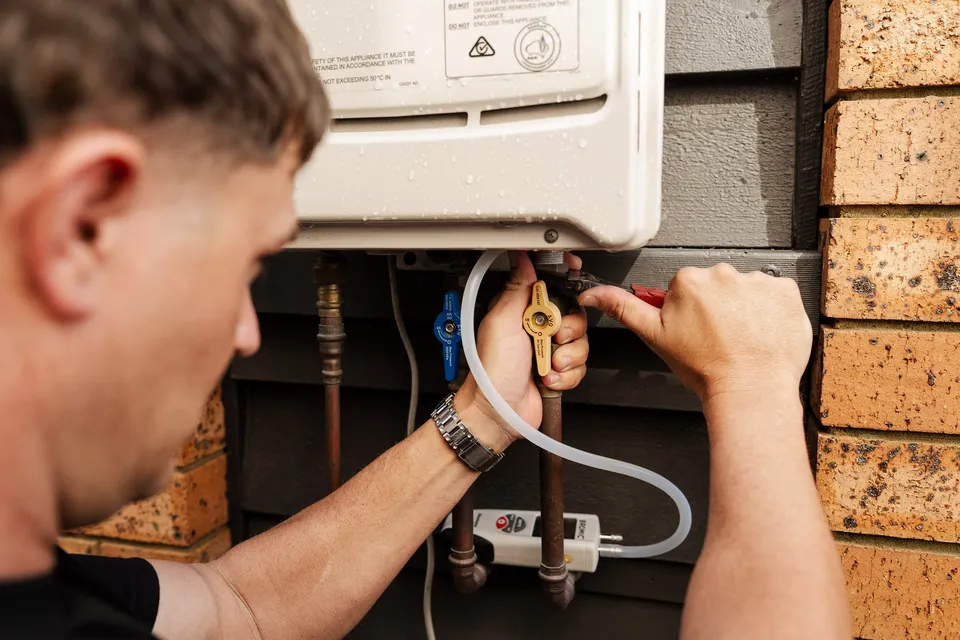
Close the isolation valve at the leaking fixture or appliance first, because that valve stops water to one outlet and leaves the rest of your unit supplied. Every tap, toilet, dishwasher and water heater should have one within arm's reach.
When the leak is bigger than a drip, more matters:
- your lot's submeter, where fitted, sits in a common area rather than inside your unit, so you may not be able to reach it yourself;
- the pipework between the master meter and the submeters, plus the fittings around each submeter up to its isolation valves, remain the scheme's to maintain.
Leave shared valves alone. Your own fixture valve is the one you're entitled to operate, and we handle anything beyond it.
Who Maintains the Source of a Leak
Leaks that reach the home below usually trace to one of a few sources, and each has a different owner:
A shower tray
your job, even when the tray sits beyond your lot.
A water heater serving one lot
also yours, wherever the tank is mounted.
A pipe inside a shared structural element
the scheme's responsibility, and the repair runs through them.
Isolate first in every case. Stop the water at the fixture's own valve, keep the fixture out of use, then call us to trace the source. Leaking shower repairs and flexi hose replacement each have their own page, and both jobs come up constantly in stacked bathrooms.
Unit Blocks Above the Reach
At the last census, flats and apartments made up 70 per cent of the suburb's homes, against 337 townhouses and 894 separate houses, so most plumbing faults here happen with neighbours above or below.
Kingsford Smith Drive still marks the old divide: heritage houses on the hills, towers on the reclaimed wharf flats. Riverside blocks tuck each flat's storage tank into a service cupboard, so a failure means shutting down a shared riser and working around building rules before anything can be swapped.
Stacked kitchens and bathrooms mean one split hose can soak several flats before anyone finds it. That's why we treat leak detection in a unit as the first step, not the last.
How We Work on Unit Plumbing
- 1

Get in touch
Call (07) 3523 6484 or send a quick message about the job in Hamilton, and we'll ask what we need to know.
- 2

We trace the fault to your lot
We check the fixture and its isolation valve, follow your lot's pipework from there, and sort what's yours from what belongs to the scheme before any quote is written.
- 3

Sign off the quote
You'll see a fixed quote before any work starts, with flat-rate pricing and no hidden fees. The job starts when you're happy with it.
- 4

Pay once it's done
Pay by card or EFTPOS on site after the work's finished, or choose Fix now, pay later.
Plumbing job in Hamilton?
$0 call-out fees, available 24/7, and same-day where we can.
Unit Plumbing Questions From Lot Owners
Call (07) 3523 6484Is plumbing in a unit covered by the body corporate in Hamilton?
Yes, the shared pipes are. A line that serves just your home, stays inside your lot and avoids every shared wall, slab or ceiling is yours instead. Queensland's three-part test settles which side any pipe falls on.
Where is the water shut-off in a Hamilton unit?
Start at the fixture. Each tap, toilet and appliance has its own isolation valve that stops water to that one outlet, and you can close it yourself. Your lot's submeter, where one is fitted, sits in an accessible common spot, never inside the home.
Does the body corporate look after my water heater?
No, not when it supplies only your lot. The owner or occupier looks after a water heater and its pipes even where the tank sits on common property. A failure in a block still usually means a shared-riser shut-off first.
Does a unit bathroom renovation need a plumbing permit?
Yes, sometimes. Most plumbing work in an existing home is notifiable, meaning the plumber lodges a Form 4 notice with the QBCC. Some apartment renovations are complex enough to need a local government permit instead, so ask us before work begins.
Is the water meter for a Hamilton unit inside the unit?
No, your meter sits outside the home. Where a submeter is fitted, Urban Utilities requires it in an accessible common area, and every new strata subdivided building has needed one since 1 January 2008. The fittings around each submeter, including its isolation valves, remain the scheme's.

Call Us About Your Unit PlumbingWe'll call you back.
Ring (07) 3523 6484 and tell us what's wrong. You get $0 call-out fees, a fixed quote before any work starts and same-day where we can, 7 days a week.
To claim your $0 call-out fee, call (07) 3523 6484 today.